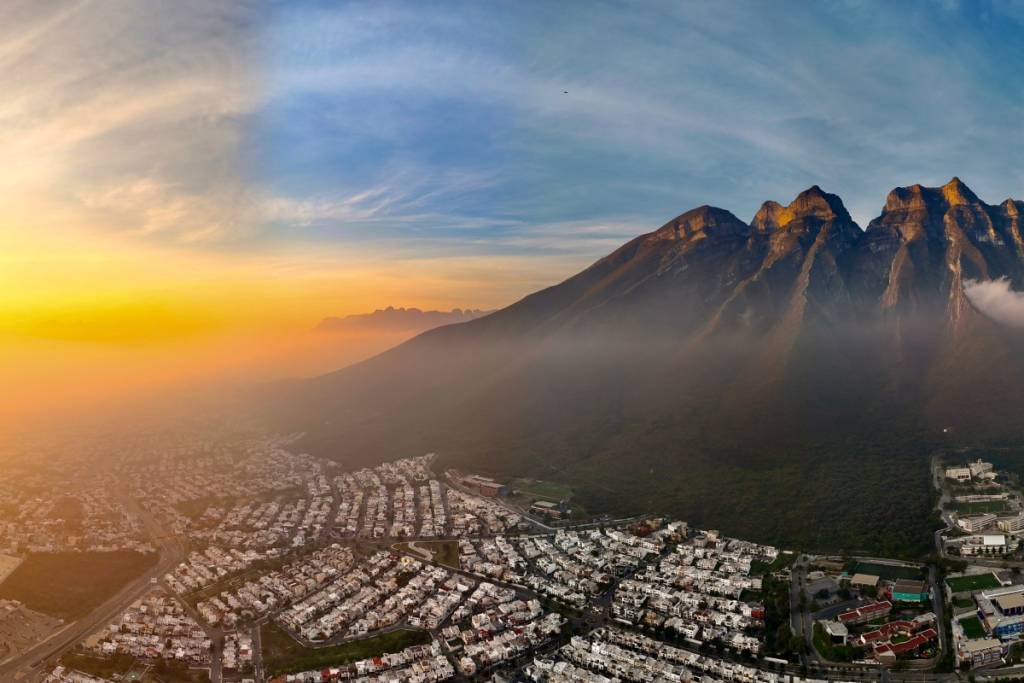

The distance between Monterrey and Saltillo is approximately 85 kilometers by road, a route that thousands of people travel every day for work, business, or tourism. However, a claim recently began circulating on social media that caught many people’s attention: that the two cities could end up “merging” in about 20 years.
Although the statement has sparked all kinds of reactions, it actually stems from remarks made by sociologist Lorenzo Alejandro López Barbosa, a professor and researcher at the Antonio Narro Autonomous Agrarian University (UAAAN), who suggested that, if the current pace of urban and industrial growth continues, the metropolitan areas of Monterrey and Saltillo could become territorially connected in about two decades.
What does it mean that Monterrey and Saltillo could merge?
Before imagining a single giant city straddling Nuevo León and Coahuila, there is an important clarification: the scholar is not referring to a political or administrative union between the two states.
The hypothesis refers to the phenomenon known as conurbation, which occurs when the growth of two metropolitan areas causes their urbanized zones to expand until they come close to or merge with one another.
In this case, factors such as the establishment of new industrial parks, housing development, economic growth driven by nearshoring, and daily commuting between Monterrey, Santa Catarina, García, Ramos Arizpe, and Saltillo could accelerate this process in the coming decades.
A projection, not an official prediction
The researcher’s statement was picked up by various media outlets and quickly began to spread on social media. However, so far, the specific study he refers to when discussing the scenario for the next 20 years has not been publicly identified.
Therefore, the idea should be understood as a projection based on current trends in urban expansion and not as a confirmed date or an official project of the governments of Nuevo León or Coahuila.
What is certain is that the Monterrey–Saltillo corridor has become increasingly important due to its industrial, logistical, and economic activity, making it one of the most dynamic regions in the northern part of the country.